What we took away from the day at Syndex.
At a time when companies must fundamentally rethink their organizational structures in the face of social and environmental challenges, Syndex hosted an event on March 12 with a telling title: “A different kind of business is possible”.
The goal: to start from reality.
No grand abstract principles, but concrete feedback, discussions and courses of action.
The day was structured in two parts:
- in the morning, participatory workshops with union members and feedback from the field
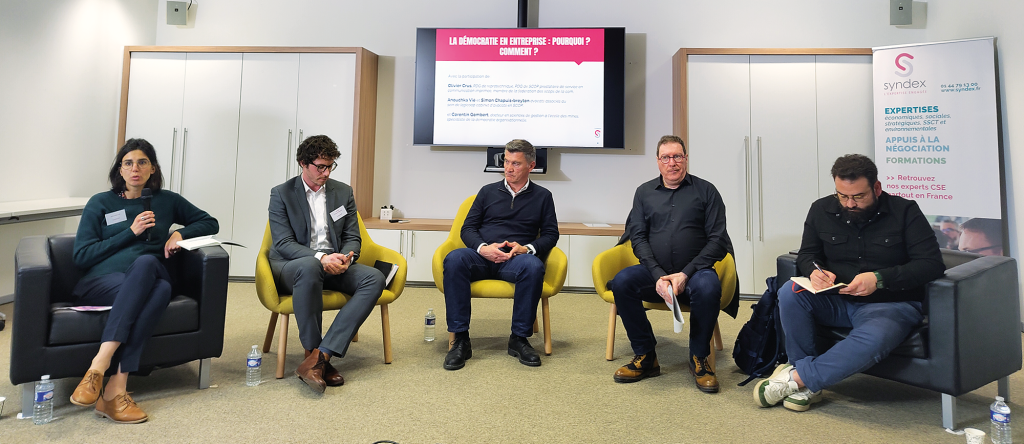
- in the afternoon, roundtables bringing together the perspectives of practitioners, researchers, and executives
With one overarching question: “How can we transform the company to make it more democratic, more just, and more aligned with planetary boundaries?” “
1. Why democratize the workplace?
As Corentin Gombert pointed out, the issue of democracy in the workplace is above all political and societal.
It stems from a fairly simple paradox:
Can one be a citizen in a democracy… and not be one at work?
Behind this question lie several observations:
- the excesses of certain economic models have very concrete impacts on society (environment, health, working conditions)
- workers’ expectations, particularly among younger employees, are changing: it’s not that they no longer want to work but that they no longer want to work the way their parents did
- companies need to become more resilient, and this also requires greater team involvement
Democratizing the company is therefore not just a matter of values.
It is also a way to better address current challenges.
2. Very concrete leverages… already at work
The morning discussions, particularly with union representatives, brought us back down to earth: transformations are already underway.
Several leverages stand out:
- legal (SCOPs, cooperatives, ESUS accreditation…)
- organizational (discussion forums, committees, expanded governance)
- contractual (implementing internal agreements, as at Norsys, see below)
- cultural (learning to debate, changing perceptions)
- technological (using tools that facilitate participation)
One point comes up often: the law and the collective agreements pave the way, but it is their adoption by the workforce—managers and employees alike—that makes the difference.
3. Inspiring Corporate Trajectories
The afternoon provided us with concrete examples.
Olivier Crus recounted the takeover of Reprotechnique as a SCOP in 2013:
- 70 jobs at risk
- 1 million euros to raise in 3 months
- a complete transformation of governance
Thirteen years later, the company is still here.
But without idealizing it:
- democratic governance must be learnt
- it creates new spaces for discussion
- it also entails new responsibilities for employees
4. Evolving professions
Another striking example: that of the law firm Légicoop, presented by Anouchka Vié and Simon Chapuis-Breyton.
Their approach:
- adopting a cooperative model
- involving the entire team in decisions (including interns)
- embodying, in their operations, the values they champion for their clients
With very concrete results:
- strong commitment
- team retention
- but also increased demands in terms of time, active listening, and the quality of dialogue
5. The key role of social dialogue
One of the central themes of the day, highlighted in particular by Dara Jouanneau (Syndex), concerns the role of social dialogue in these transformations.
How can we leverage social dialogue to transform our company rather than viewing it as a legal constraint?
Several leverages emerged:
- better equipping employee representatives
- enhancing access to information (particularly on environmental issues)
- creating genuine spaces for discussion on trade-offs
These tools must enable us to overcome the tensions that are very much present: jobs vs. the environment, short-term vs. long-term, economic constraints vs. impact.
6. Democracy in the workplace: a demanding ideal
The day also helped move away from an overly “idealized” vision by highlighting some realities:
- not everyone wants to participate in decision-making
- democracy takes time
- the risk of burnout can be all the greater if employees are more engaged and involved
Hence the importance of creating spaces for collective oversight and vigilance.
7. What if nature were part of governance?
This is undoubtedly one of the most fundamental topics discussed.
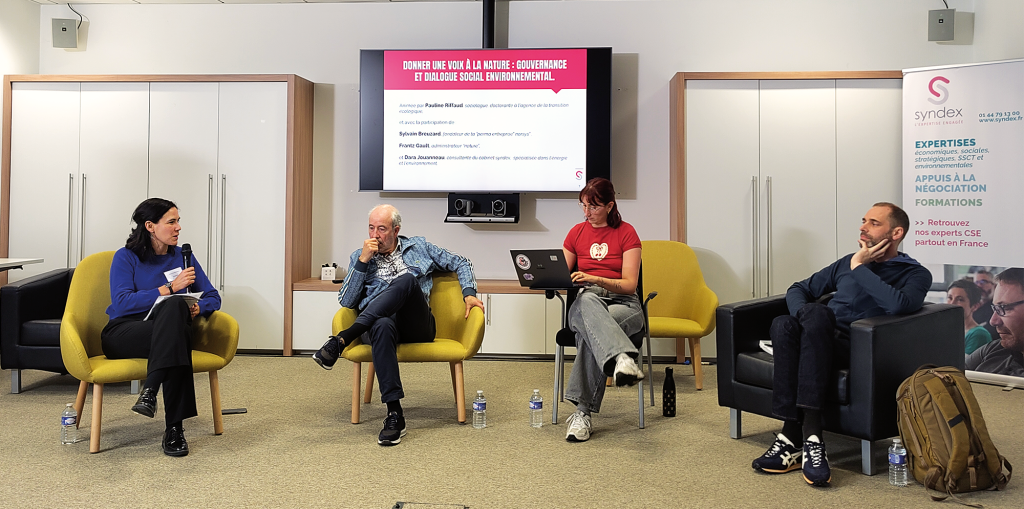
Frantz Gault proposes a radical shift: what if nature were no longer just an issue… but a shareholder in the company?
Three ways of viewing it are emerging today:
- Nature as a stakeholder
- Nature as a worker
- Nature as a shareholder (his favorite but also the most ambitious)
With this thought-provoking remark: “We never consider that nature is part of the demos.”
8. Norsys: putting it into practice
Sylvain Breuzard, CEO of Norsys, and Christophe Prochet, CFDT union representative at Norsys, shared with us what the company is already implementing:
- a High Commission for Nature
- taking the 9 planetary boundaries into account
- the involvement of experts to represent living systems in governance bodies
- a company agreement resulting from the “permadialogue” aimed at integrating social and environmental issues into social dialogue (Microsoft Word – permadialogue – PRESS KIT der)
These initiatives are still rare, but they open up very concrete possibilities.
Some questions to keep in mind
- Who really makes the decisions in my organization?
- Who is missing from today’s discussions?
- What spaces for dialogue actually exist?
- How are conflicts between economic, social, and environmental issues resolved?
Conclusion
This day did not yield a ready-made model. On the contrary, it demonstrated that change is driven by companies, unions, and researchers who question, experiment, and adapt.
We move forward with imperfect tools, sometimes limited frameworks, and many questions still unanswered.
A different kind of business is possible, yes.
It is being built through a multitude of concrete experiences that, when taken together, begin to sketch out something new.